
Why AI policing of track limits isn’t a good idea
The pitch sounds great — the reality is messy
The FIA’s newer workflow promises near‑real‑time, semi‑automated detection of track‑limit events. It combines computer vision with distributed processing and positioning/micro‑sector timing to flag incidents faster and reduce human review. On paper, this means speed, consistency, and fewer bottlenecks. Public reporting by GPFans and Nextgen‑Auto outlines how ECAT integrates with RaceWatch to automatically flag potential infringements while stewards retain final authority.
In practice, this approach inherits well‑known weaknesses from computer vision and human‑machine decision systems. When the goal is regulatory enforcement, those weaknesses become risks.
Computer vision bias: lighting, color, angles, occlusion
Even mature vision pipelines are sensitive to how footage is captured and rendered:
- Lighting variance and shadows: Persistent glare, cloud cover changes, sunset angles, and floodlights alter edge contrast on white lines. That skews segmentation, which is critical for boundary detection.
- Paint, tire marks, and kerb patterns: Worn paint and rubber deposition can blur the “ground truth” geometry the model expects, increasing false positives/negatives.
- Car color and livery contrast: Silhouette recognition and per‑frame tracking degrade when bodywork colors blend with background tones; darker cars under low light or high‑gloss liveries under glare are frequent failure cases.
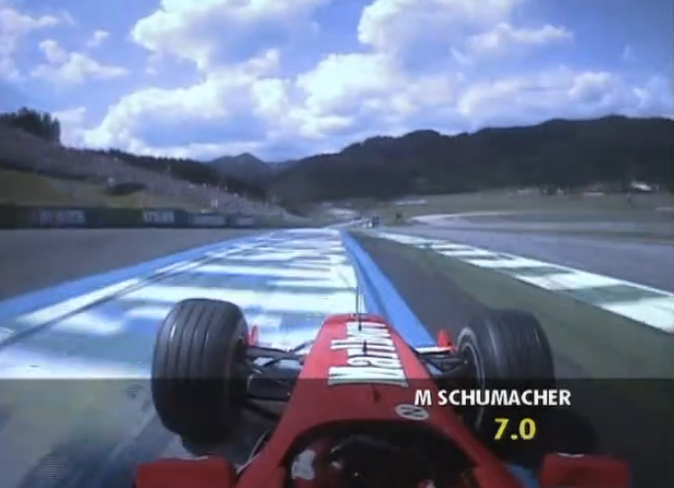
- Camera placement and occlusion: Low‑angle lenses, high‑speed pans, and multi‑car stacks can partially hide the contact point between tyre and line, producing ambiguous frames when the decision needs to be binary.
- Weather domain shifts: Rain, spray, heat shimmer, and debris change textures in ways models trained on “clean” data don’t generalize to reliably.
A system that “works most of the time” is still unsuitable as the primary arbiter when stakes are regulatory. Edge‑case reliability is the standard.
Data fusion is not a silver bullet
Combining micro‑sector timing, reference lines, and geofencing helps cross‑validate events, but each input can drift:
- Positioning drift and sampling: Latency and interpolation differences between timing loops and positioning feeds can move the inferred crossing point by crucial centimetres.
- Geofencing overreach: Virtual zones that trigger alerts can fire on atypical lines or evasive manoeuvres that are permissible, especially during multi‑car sequences.
- “Ideal line” assumptions: Using deviations from an “optimal” line as a proxy for off‑track behaviour risks misclassifying driver choices in defence or avoidance as violations.
Distributed GPU processing increases throughput; it doesn’t guarantee that fusion logic resolves the ambiguous edge frames that decide outcomes.
Automation bias: when speed overrules judgment
When a tool filters out “95% of cases” before stewards look, people naturally infer that the remaining 5% are the only ones worth scrutiny. That is textbook automation bias: human reviewers over‑trust pre‑sorted outputs, miss false negatives, and accept borderline classifications without sufficient contestability.
This shifts control away from human stewards in two ways:
- Review bandwidth narrows to whatever the system flags, not what a human might question.
- Escalations start from the machine’s framing, which can anchor subsequent reasoning and make reversals rarer.
Faster isn’t always fairer. In officiating, the first duty is due process, not throughput.
Transparency and auditability must lead
If semi‑automated detection is used, minimum safeguards should include:
- Full evidence packets per alert: raw frames, camera metadata, fusion inputs, thresholds, and confidence scores.
- Circuit‑specific calibration reports: illumination profiles, camera angles, and known failure modes published before each event.
- Human‑in‑the‑loop overrides: explicit pathways to review non‑flagged sequences, plus obligations to sample “cleared” events to detect false negatives.
- Post‑race audits: independent spot checks comparing machine outcomes to human re‑adjudication on representative samples.
Without these, consistency can become consistently wrong.
Circuit context: why event conditions matter
Changing light, tree cover, mixed kerb textures, and frequent traffic stacks create exactly the visual edge‑cases that stress automated detection. Albert Park is a good example, but similar conditions appear at many circuits, which is why caution should be the default — not over‑reliance on black‑box flags.
What fans can use today
PenaltyWatch includes a live track‑limit violations counter during sessions, alongside incident timelines and steward decisions. It’s built for transparency: you can see events as they’re logged and follow the official deliberations without guessing.
Sources
- FIA will use AI to police F1 drivers and here’s how it works — GPFans
- F1 to deploy AI system in latest track limits crackdown — Nextgen‑Auto
Want to judge the race yourself?
Get real-time steward decisions and AI analysis directly on your phone.
Download PenaltyWatch